Wednesday, April 23, 2008

Gameshark For Pokemon Emerald Rom

Book Day

my beloved Rinzewind , I take the day dle book to recommend my essentials about math. These books all fond of math can not stop reading, even if it is an expert on the subject.
These readings are accessible to all audiences, and are able to open any mathematical curiosity:
  1. The Number Devil by Hans Magnus Ezsenberger. An approach to certain subjects of arithmetic and geometry counted as a collection of short stories: A conversation with a devil child. Essential for both children (from 1 º ESO) and adults.
  2. aNumber Man, Jonh Allen Paulos. Reflections on the ignorance of basic math concepts such as fractions, basic probability, percentages ... and the consequences (sometimes terrible) that entails. We read in one go and leaves you wanting to read more. It is by far the best popular book I've read mathematics.
  3. The Fermat's Enigma by Simon Singh. It is a novel based on a BBC documentary about the show in 1993 the little Fermat theorem. A fictionalized journey through the history of algebra and its characters. If you are a reader of novels you should not miss it.
  4. Alice in Wonderland, by Lewis Carroll. This classic can be read in two ways: as the wonderful story that is sought or mathematical logic. Lewis Carroll, in addition to writing, deacon, photographer and teacher was an authority on mathematical logic, and reflected all logic known to his time on the adventures of Alice following the white rabbit. Discussions with the Cheshire Cat or Mad Hatter are priceless. Even basic concepts forward the theory of relativity many years before Einstein gave them names.
  5. "The Lady or the Tiger? Raymond Smullyan. Games, quizzes and logic puzzles. For fans of puzzles. A classic.
There are many others, but, in my humble opinion, these are the whole everyone should read at least once before dying.

Monday, April 21, 2008

Magnum Condoms Vs Regular

A sequence that is not

I propose John (someday I should write about it) the following game:
5, 4, 2, 3, 1
are the numbers 1 to 5 ordered by some criterion diabolical.
If we add the numbers six, seven and eight, the sequence becomes:
5, 4, 2, 8, 6, 7, 3, 1
And when you add nine and ten:
5 , 4, 10, 2, 9, 8, 6, 7, 3, 1
The challenge is to find that view diabolical.
The answer, as always in the comments or in a post within a week.

Tuesday, April 15, 2008

Dresden Figurine Marks

's tail Inheritance of numbers

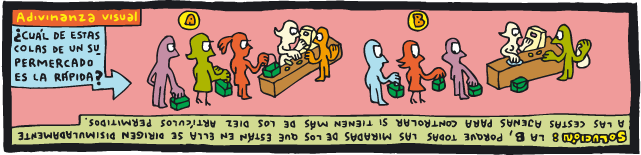
Today in the newspaper Público, Mauro Entrialgo makes a joke about the speed of the queues at the supermarket.
Observing Entrialgo Mauro reminds me of one thing: When you are in the supermarket checkout line to pay, do not have never had the feeling that you have placed in the tail slow? Apparently it's a widespread feeling that is accentuated the more quickly we have. That perception is, of course, wrong, but it contains some truth. Imagine that you make
Shopping in a supermarket that is open five boxes. It is assumed that the five pockets are equally efficient in all the queues there are equal numbers of people. For some reason (delay to pay misbranded articles ,...) there is always a queue that is the quickest and four others are slower. Therefore, the probability of choosing the fastest line is 1 / 5 (one of every five times), ie 20%. In other words, the probability that any row forward faster than yours is 80%. Or that in five times you put in the queue to pay four of them will be another row faster than yours.
Now let's do the reverse analysis: No Whatever the row in which we place ourselves. That row is really only the slowest in 20% of cases (only one out of five times).
The client generally stressed, is not able to do this analysis, one sees that there is another row that is faster than yours and perceived to be wrong to choose from. That, put into words, means that " and touched my slower row."
If instead we have five boxes 10 (imagine the Alcampo the first Friday of the month) the percentages are 10% (to choose the fastest line) and 90% (to pick one that is not the most fast).
With 15 open boxes, the probability to choose the fastest is less than 7% of the time (the exact figure is 6'666 ...%), while the probability of a cash faster than ours soars to nearly 94%. Ie the perception cash was mistaken increases with the number of boxes: how many more boxes open, more people will think that your rank is the slowest. In the case of 15 boxes, 93% of customers think that the line moves too slowly, irrespective of the speed at which it does.
These feelings wrong, come from the fact that most people are not familiar with the most basic concepts of probability. Put another way, namely math makes us happier .

Wednesday, April 9, 2008

Sage Tea In Cold Storage Singapore

supermarket.

As promised, we go with the solutions.
  • First:
1, 4, 9, 25, ...
are the squares of whole numbers: 1 2 = 1, 2 2 = 4, 3 2 = 9, etc.
  • The second:
3, 1, 4, 1, 5, 9, 2, ...
are the first decimal digit of pi = 3'141592 .... I recognize that this was a bit tricky.
  • The third:
3, 3, 4, 6, 5, 4, 5, 4, ... Here are
to explain a little. The first is 3 because the word ONE has three letters. The second is 3 because the DOS word has 3 letters. THREE word has 4 letters, the word has 6 letters FOUR, FIVE word has 5 letters, the word has 6 letters SIX ... It is far-fetched, I know, but what's hot?

Do any of the readers of this blog would like to propose others? We are open to suggestions.

Tuesday, April 8, 2008

Thick Gooey Sticky Brown Discharge

Solution What is mathematics? Statistics

One reason for the low level of high school students in math is totally wrong and twisted view that their teachers have and therefore give them. Most math teachers I know are not specialists in the field: are physical, chemical, computer and give students their own (and wrong) view of mathematics.
The next example I gave it to John, a peculiar kind and admirable (I'll talk about it.) Convincingly illustrates the difference between mathematics and other sciences:
any course in any college math professor comes into class, and without saying a word written on the blackboard:
2 +2 = ?
loose chalk and see their students waiting for a response. They puzzled respond in chorus:
2 +2 = 4
The professor then pick up your chalk and writes
4 =?
perplexed students do not know what to say. Finally, one of them dares to say: Infinity?

That's the difference between mathematics and other sciences. Mathematics has more to do with creativity and the pursuit of beauty in science and mathematics.

Dancing On Beach Painting

absurd

These phrases are mostly jokes about statistics and probability that mathematicians have each other. However, just shop around newspapers or television news to find that most people believe that things are well: Ear
  1. man time: "We expect a rainy weekend. The probability of rain on Saturday is 50% and the same for Sunday, so it'll rain this weekend in all probability"
  2. The Coca-Cola is very bad health, although the formula has improved over time. Everyone who took between 1900 and 1910 have died. This mortality rate is reduced as time progresses. Virtually all consumers of Coca-Cola aúun live births since 1995.
  3. When a train crash in the last car is where it produces the highest mortality rate (this is a true fact.) That is why the National Railway Company is considering delete the last car of each train.
  4. To a statistician, English media has a tit and a half penis.
  5. The 66,6% of dentists surveyed opted for a sugar-free gum (We could not convince the Doctor Morales).
  6. Nine out of ten dentists agree that one in ten dentists are idiots.
  7. Most people have a number of fingers than average.
  8. Recent research shows that in 90 English, 45 are half.
If you do not see the grace you should review some basic math concepts ... and put it in the comments.