Today in the newspaper Público, Mauro Entrialgo makes a joke about the speed of the queues at the supermarket.
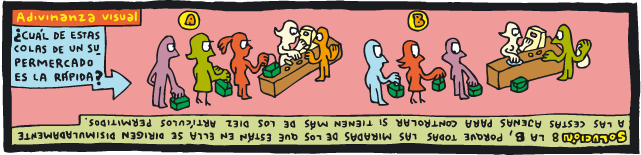 Observing Entrialgo Mauro reminds me of one thing: When you are in the supermarket checkout line to pay, do not have never had the feeling that you have placed in the tail slow? Apparently it's a widespread feeling that is accentuated the more quickly we have. That perception is, of course, wrong, but it contains some truth. Imagine that you make
 Shopping in a supermarket that is open five boxes. It is assumed that the five pockets are equally efficient in all the queues there are equal numbers of people. For some reason (delay to pay misbranded articles ,...) there is always a queue that is the quickest and four others are slower. Therefore, the probability of choosing the fastest line is 1 / 5 (one of every five times), ie 20%. In other words, the probability that any row forward faster than yours is 80%. Or that in five times you put in the queue to pay four of them will be another row faster than yours.
Now let's do the reverse analysis: No Whatever the row in which we place ourselves. That row is really only the slowest in 20% of cases (only one out of five times).
The client generally stressed, is not able to do this analysis, one sees that there is another row that is faster than yours and perceived to be wrong to choose from. That, put into words, means that " and touched my slower row."
If instead we have five boxes 10 (imagine the Alcampo the first Friday of the month) the percentages are 10% (to choose the fastest line) and 90% (to pick one that is not the most fast).
With 15 open boxes, the probability to choose the fastest is less than 7% of the time (the exact figure is 6'666 ...%), while the probability of a cash faster than ours soars to nearly 94%. Ie the perception cash was mistaken increases with the number of boxes: how many more boxes open, more people will think that your rank is the slowest. In the case of 15 boxes, 93% of customers think that the line moves too slowly, irrespective of the speed at which it does.
These feelings wrong, come from the fact that most people are not familiar with the most basic concepts of probability. Put another way, namely math makes us happier .


0 comments:
Post a Comment